Hydraulic swing shearing machine
A swing beam shear arcs the upper blade through the sheet — the common configuration for general sheet metal cutting, forgiving to set up and straightforward to maintain. 29 standard models from 4 to 25 ton.
What this machine is
A hydraulic swing shearing machine cuts sheet metal with a straight top blade descending through the material onto a bottom blade. The upper blade holder pivots around a fixed point, so the blade travels an arc rather than dropping vertically — the swing beam principle. It is the standard configuration for general sheet metal cutting: simpler structure than a guillotine, easier to set up and maintain, and lower cost at the same tonnage.
We build these in 29 standard models from 4 x 2500 to 25 x 3200(tonnage x cutting length in mm), in both NC and CNC backgauge configurations. Special models are custom-built to order.
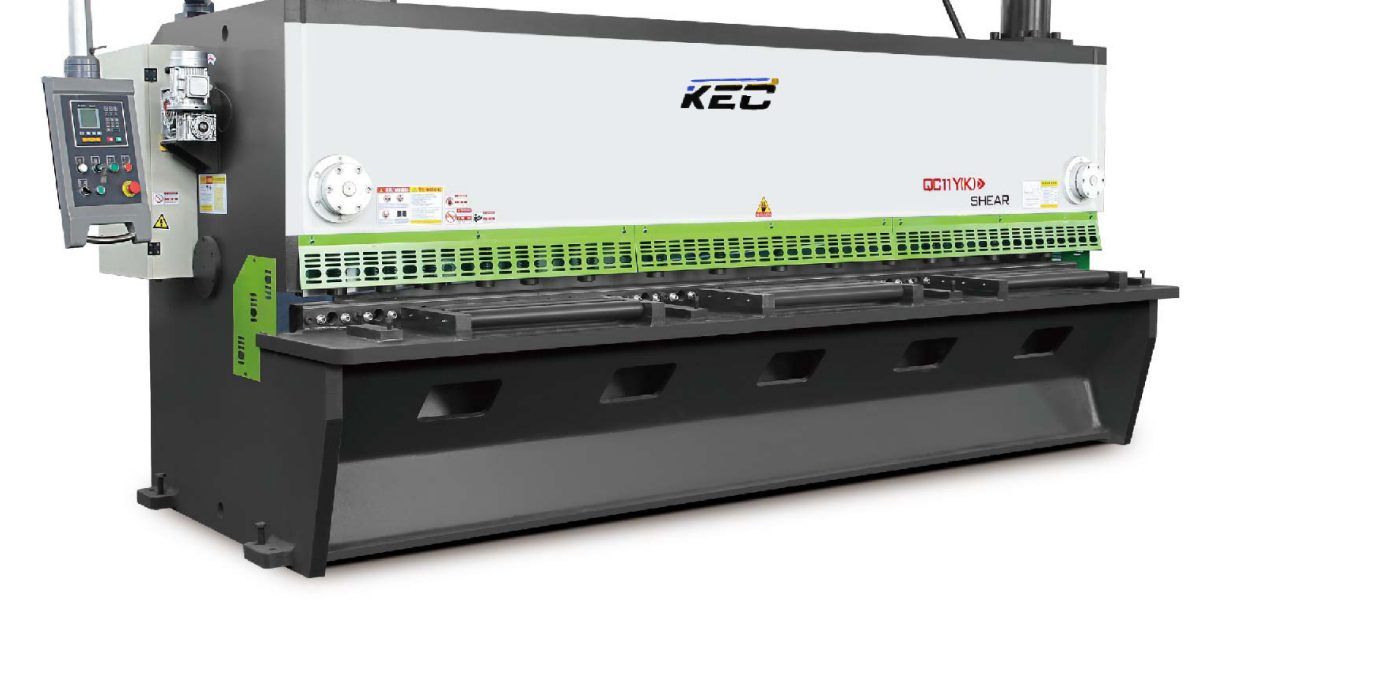
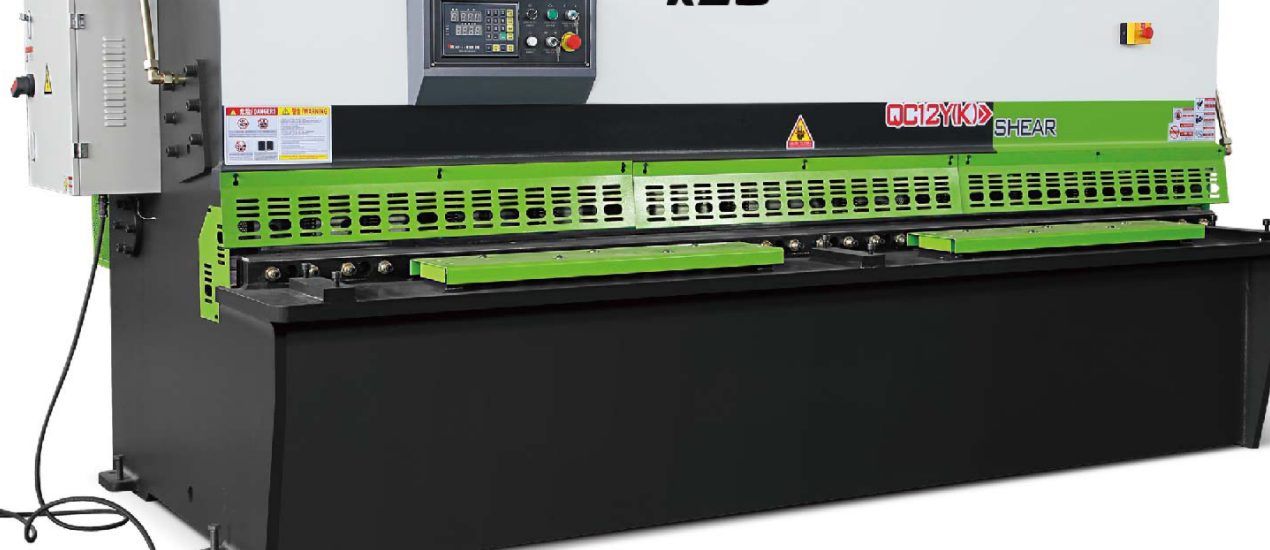
Specifications
| No. | Model | Shear angle | Strokes (spm) | Backgauge (mm) | Throat (mm) | Table (mm) | Main motor (kW) | Size LxWxH (mm) | Weight (kg) |
|---|---|---|---|---|---|---|---|---|---|
| 1 | 4 x 2500 | 1°30' | 18 | 20–500 | 300 | 800 | 4 | 3200 x 1600 x 1500 | 3,900 |
| 2 | 4 x 3200 | 1°30' | 14 | 20–600 | 300 | 800 | 5.5 | 3900 x 1650 x 1620 | 4,800 |
| 3 | 4 x 4000 | 1°30' | 12 | 20–600 | 300 | 800 | 5.5 | 4700 x 1900 x 1700 | 6,500 |
| 4 | 4 x 6000 | 1°30' | 10 | 20–600 | 300 | 800 | 7.5 | 6700 x 1900 x 1800 | 7,900 |
| 5 | 6 x 2500 | 1°30' | 18 | 20–600 | 300 | 800 | 7.5 | 3200 x 1650 x 1620 | 4,800 |
| 6 | 6 x 3200 | 1°30' | 14 | 20–600 | 300 | 800 | 7.5 | 3900 x 1650 x 1620 | 5,800 |
| 7 | 6 x 4000 | 1°30' | 12 | 20–600 | 300 | 800 | 7.5 | 4700 x 1850 x 1700 | 7,900 |
| 8 | 6 x 6000 | 1°30' | 8 | 20–600 | 300 | 800 | 11 | 6800 x 1950 x 1850 | 9,200 |
| 9 | 8 x 2500 | 1°30' | 14 | 20–600 | 300 | 800 | 7.5 | 3200 x 1650 x 1620 | 6,000 |
| 10 | 8 x 3200 | 1°30' | 12 | 20–600 | 300 | 800 | 11 | 4000 x 1650 x 1620 | 6,800 |
| 11 | 8 x 4000 | 1°30' | 10 | 20–600 | 300 | 800 | 11 | 4480 x 1800 x 1700 | 9,000 |
| 12 | 8 x 6000 | 1°30' | 8 | 20–600 | 300 | 800 | 15 | 6850 x 2050 x 1780 | 10,500 |
| 13 | 10 x 2500 | 1°30' | 10 | 20–600 | 300 | 800 | 11 | 3200 x 1800 x 1700 | 6,500 |
| 14 | 10 x 3200 | 1°30' | 10 | 20–600 | 300 | 800 | 11 | 3900 x 1950 x 1900 | 7,800 |
| 15 | 10 x 4000 | 1°30' | 8 | 20–600 | 300 | 800 | 18.5 | 4700 x 2100 x 2100 | 12,000 |
| 16 | 10 x 6000 | 1°30' | 6 | 20–600 | 300 | 800 | 22 | 6800 x 2200 x 1800 | 22,000 |
| 17 | 12 x 2500 | 1°30' | 11 | 20–600 | 300 | 800 | 15 | 3200 x 2060 x 1960 | 8,500 |
| 18 | 12 x 3200 | 1°30' | 10 | 20–600 | 300 | 800 | 18.5 | 3900 x 2120 x 2100 | 9,500 |
| 19 | 12 x 4000 | 2°30' | 8 | 20–600 | 300 | 800 | 18.5 | 4700 x 2200 x 2100 | 12,000 |
| 20 | 12 x 6000 | 2°30' | 5 | 20–600 | 300 | 800 | 22 | 6850 x 2250 x 2200 | 28,000 |
| 21 | 16 x 2500 | 2°30' | 8 | 20–600 | 300 | 800 | 18.5 | 3200 x 2127 x 2000 | 10,000 |
| 22 | 16 x 3200 | 2°30' | 7 | 20–600 | 300 | 800 | 22 | 4000 x 2400 x 2100 | 12,000 |
| 23 | 16 x 4000 | 2°30' | 6 | 20–600 | 300 | 800 | 30 | 4800 x 2200 x 2200 | 16,000 |
| 24 | 16 x 6000 | 2°30' | 6 | 20–600 | 300 | 800 | 37 | 6800 x 2250 x 2280 | 32,000 |
| 25 | 20 x 2500 | 2°30' | 6 | 20–600 | 300 | 800 | 30 | 3230 x 2250 x 2150 | 14,000 |
| 26 | 20 x 3200 | 2°30' | 5 | 20–600 | 300 | 800 | 30 | 3900 x 2260 x 2200 | 17,000 |
| 27 | 20 x 4000 | 2°30' | 4 | 20–600 | 300 | 800 | 37 | 4800 x 2260 x 2400 | 18,000 |
| 28 | 25 x 2500 | 2°30' | 4 | 20–600 | 300 | 800 | 37 | 3250 x 2280 x 2180 | 18,000 |
| 29 | 25 x 3200 | 2°30' | 4 | 20–600 | 300 | 800 | 37 | 3900 x 2280 x 2250 | 22,000 |
Specifications per the factory catalogue. The above are standard machine models; special models can also be customized.
Reading the model table
The model number reads as tonnage x cutting length — a 6 x 3200 shears 6 mm mild steel across a 3200 mm blade. Two things move together in the table and are worth understanding before you pick a row:
- Shear angle steps at 16 mm. Models up to 12 mm capacity run a 1°30' shear angle; 16 mm and above run 2°30'. The larger angle reduces cutting force on thick plate — it is a tonnage decision, not an accuracy option.
- Strokes fall as the machine grows. From 18 strokes per minute on the small models down to 4 on the largest. If your work is high-volume thin sheet, the stroke rate matters as much as the capacity — a machine one size larger than you need costs you cycle time every shift.
Machine structure
The parts that decide whether the machine still cuts straight in year five:
- Frame. Built from split steel plates, welded and then tempered in a large tempering furnace to relieve the stress from welding and machining — the step that decides whether the frame holds its geometry. The whole machine is machined as one piece where it matters: more rigidity, more stable precision, less assembly error, less deformation over the machine's life.
- Hydraulics. Rexroth valve blocks for the hydraulic circuit, backed by a hydraulic overload protection system with real-time oil pressure monitoring — oil leaks and sticking valves are rare on machines built this way, and the operator can see the pressure rather than discovering a problem by its consequences.
- Blades and blade gap. Ground upper and lower blades with adjustable clearance — clearance set proportional to material thickness and type is what keeps the edge square and the burr down. We supply the blade set, and clearance adjustment is routine maintenance, not a defect.
- Backgauge. A heavy-duty rear stopper built to resist impact and deformation, on a frame that makes loading and unloading cut material straightforward. Manual and automatic backgauge lifting are both available, so long material can be positioned without lifting it over the fence.
- Front table. A spherical integrated front support that reduces friction between sheet and table — feeding wide sheet is faster and the sheet surface stays clean.
- Cutting line lighting. A standard alignment device projects a line shadow onto the sheet from the machine's own light source, replacing the old mark-and-cut method with a straight reference you can cut to.
- Feed opening. Minimum feed height equals sheet thickness; maximum equals sheet thickness plus 20–25 mm, set with height-adjustable screws. A front guard plate and side rails keep the operator clear, and the feed guard carries an induction switch — lift it during operation and the machine cuts power automatically.
- Lubrication. Automatic or manual lubrication, both available — choose to suit how the machine is run.
- Rear protection. Photoelectric protection across the rear of the cutting area, guarding the operator and especially fingers at the point of operation.
- Pneumatic rear support. Supports wide sheet during cutting and folds away with one action when not in use.
Control system and drive
The machine runs an E21S control system on a PLC industrial computer. The main motor is available from international brands such as Siemens or established domestic brands, and voltage is built to order — three-phase 220 V / 60 Hz, 380 V / 60 Hz, 415 V / 60 Hz and other configurations for North American and other grids, so a US shop can wire the machine to its existing service rather than rebuilding the panel.
Main configuration
| Item | Component | Brand / note |
|---|---|---|
| 1 | Control system | E21S |
| 2 | Hydraulic pump | SUNNY (USA) / Foster (China) |
| 3 | Hydraulic valve | Bosch Rexroth |
| 4 | Main motor (option) | Huyuan (Shanghai) / Estun (Nanjing) |
| 5 | Electrical components | Schneider / Chint |
| 6 | Seals | NOK (Japan) or German brand |
| 7 | Backgauge servo motor (option) | Estun (Nanjing) |
| 8 | Ball screw (option) | Heqing (Taiwan) |
| 9 | Linear guides | Heqing (Taiwan) |
| 10 | Blades | Jinshan (Shanghai) |
| 11 | Cylinder | Taifeng (Jining) |
| 12 | Pipe fittings | JS (Germany) |
| 13 | Foot switch | VIKEN |
| 14 | Lubrication pump (option) | Domestic |
| 15 | Backgauge encoder (option) | Keli / Lion |
What ships with the machine
One complete hydraulic swing shearing machine, plus adjusting bolts, front material supports and a foot switch as standard accessories. Documentation: packing list, certificate of conformity, electrical and mechanical operating manuals, system data, electrical schematics, foundation drawing, handheld toolbox, wrench set and oil can.
Installation conditions
- Power: 380 V ±10%, 50 Hz — or custom voltage
- Ambient temperature: 5–38 °C while operating
- Relative humidity: 20–80% RH
- Sited away from strong vibration and electromagnetic interference sources
- No harmful or corrosive gases, no dust
Installation, training and after-sales
- Foundation. We provide the foundation drawing; you are responsible for the construction work.
- Shipment notice. When the machine is assembled at our works, we notify you of the shipment schedule and what to prepare for installation.
- Installation and commissioning. Our engineers install and commission the machine at your site, with your cooperation — you provide lifting equipment, water, electricity, hydraulic oil and the necessary conditions.
- Training. During installation and commissioning we train your technical staff free of charge and provide technical consultation. If you need an engineer to travel for debugging, that cost is reimbursed at actuals.
- Acceptance. On completion, both parties inspect and accept the machine jointly against the signed technical agreement and its attachments.
- Warranty. Three-guarantee policy from the date of sale, with a three-year quality guarantee from the date of acceptance. Within the warranty period, component damage not caused by the user is replaced free of charge; wearing parts are excluded.
Related
- Hydraulic guillotine shearing machine — the vertical-blade range, 4–30 ton, cutting lengths from 1.6 m
- Shearing machine: which type do you need? — swing beam vs guillotine, sizing and matching to the brake
- CNC hydraulic press brake — the bend side of the same cell
- How much tonnage do you need? — sizing logic that applies to both machines
Ask about the hydraulic swing shearing machine
Send the part you need to bend and we will come back with a configuration and a quote.