CNC hydraulic press brake
Hydraulic press brakes have been the backbone of our factory since 2008. Torsion bar machines for straightforward work, full CNC machines with multi-axis backgauges for batch production.
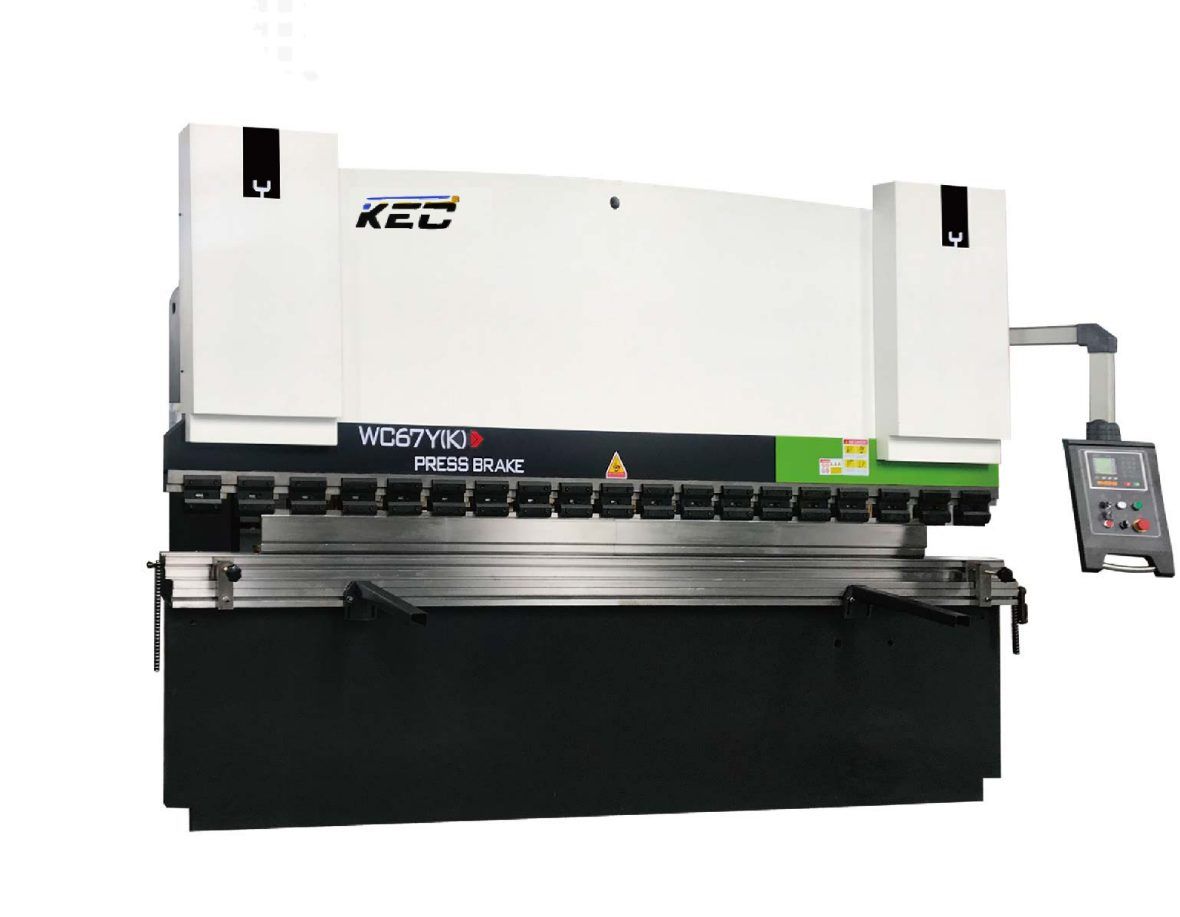
What determines whether a standard machine works
Tonnage and bed length are what get quoted. What decides whether the machine can actually make the part are three other numbers: throat depth, daylight (open height), and stroke. Most parts that fail on a standard machine fail on one of these, not on tonnage.
When you send us a drawing, we check those first. If the geometry does not clear, we will tell you whether it is worth changing the frame, or whether a different tooling profile gets you there.
Control configurations
- NC / E21-Class — backgauge positioning and stroke control for repeat work that does not need angle programming.
- CNC with multi-axis backgauge — X, R, Z1/Z2 with programmable finger positions. For batches where setup time dominates.
- Electro-hydraulic servo — pressure and position control on Y1/Y2 for consistent angles across the bed, and lower standing energy draw.
Controllers fitted across the range: Cyberec (Cybelec), Delem,Estun, ESA and Sanyuan — specified against the axis count the job needs rather than against a brochure. The standard CNC build is 3+1 axes; the backgauge can be ordered up to six axes where the part demands independent gauging at both ends. The axis map is the same on every machine:
- Y1 / Y2 — ram position, one axis per main cylinder. Two axes on every machine; closed-loop only on the servo builds.
- X — backgauge forward and back: the distance from the bend line to the gauge face.
- R — backgauge beam, carrying the gauge fingers across the bed so both ends of a long part gauge independently.
- Z1 / Z2 — backgauge fingers up and down, for gauging on the flange side of an already formed part.
- V — worktable crowning compensation, computed from plate thickness, die opening and material on the CNC builds.
Tooling
The machine arrives set up for one clamping standard, and every later tooling purchasing depends on which one. Getting this decision wrong at the quoting stage is expensive to undo — European and Asian style tangs, for instance, are close in size but not interchangeable. Tell us which tooling you already own and we match the clamping, rather than forcing a new system on you.
How to choose the right configuration
The most useful thing you can send before asking for a price is the part itself — a drawing or a sample — not a machine model. From one part we can read off the numbers that actually drive the build: the tonnage your worst bend needs, the bed length that clears your longest piece, the throat depth that lets the return clear the frame, and the daylight that fits your tooling stack plus the part. The control level is then chosen to match how you run the job, not to win a spec sheet.
How the axes interact
A press brake is a set of independent motions, and each axis you add is a cost and a setup responsibility. Y1/Y2 are the two ram cylinders — on a servo machine they are closed-loop controlled so the angle holds across the bed. X is the backgauge in and out; R is its height; Z1/Z2 move the backgauge fingers left and right independently so one setup can hit several bend lines. A shop doing one repeated bracket needs X and little else. A shop forming a different panel every day needs R and Z1/Z2 to avoid re-fixturing between runs. Add axes to the point where they pay back in setup time, not past it.
When a torsion bar or NC machine is enough
Plenty of real production is plain repeat bending: the same few angles, the same backgauge positions, day after day. For that work a torsion bar or NC machine holds the angle well enough and costs less to buy and maintain. The full servo CNC earns its money when angles change job to job, when the bed is long enough that ram sync matters, or when tolerances are tight enough that manual correction eats your margin. Be honest about which camp you are in before paying for the top tier.
Common mistakes buyers make
- Buying tonnage first. Picking a tonnage number, then finding a machine, instead of sizing from the part. The part defines a required force and a bed, throat and daylight — a machine with the right tons can still refuse the part on any one of the other three.
- Mismatching the tooling clamp. Locking into a clamping standard at the quoting stage without checking what you already own. If your existing punches and dies use a different tang, every future tooling purchase is either a compromise or a replacement.
- Overspecifying the control. Paying for multi-axis servo sync on work that is plain repeat bending. The extra axes and the commissioning they need are real cost that only pays back if your setup time actually dominates.
- Ignoring installation realities. Floor loading, ceiling height on the return stroke, and door width decide whether the machine can be delivered and installed at all. These are physical limits, not options — flag them at quote time.
When you do not need a CNC hydraulic press brake
A CNC hydraulic brake is the right tool for a lot of work, but it is not the right tool for all of it. Honest cases where you should look elsewhere:
- Your constraint is power or space, not capacity. If a standard three-phase supply is not available and the workshop is tight, the small tonnage range and our single phase guide describe a better fit.
- You only form a handful of angles a year. A manual or NC machine covers occasional work for far less capital, and the operator time you save on a CNC is value you would not use.
- Your parts are consistently long but shallow. If length is the only challenge, atandem configuration or a matched shear-plus-brake cell may serve you better than a heavier single machine.
- You need a different process entirely. Rolling, laser cutting or punching are not what a brake does. Buying a brake will not fix a job that was never a bending job.
Questions buyers ask
What is the difference between NC, CNC and electro-hydraulic servo controls?
NC (often an E21-class controller) handles backgauge positioning and stroke for repeat work without angle programming. A full CNC adds programmable bend angles and multi-axis backgauges (X, R, Z1/Z2). Electro-hydraulic servo adds closed-loop position and pressure control on Y1/Y2 so the angle stays consistent across the bed. Pick the level your setup time and tolerance demand, not the highest spec available.
How do I know what tonnage I actually need?
Start from your worst single bend — thickest material, longest length, hardest alloy, smallest V-opening — and the bend method (air bend needs the least, bottoming or hemming several times more). A long-standing planning rule is a V-opening about 8x material thickness for air-bent mild steel, but confirm the real force against your tooling maker's tables. Send us those numbers and we size the machine rather than guessing from a generic table.
Does the machine come ready for my existing tooling?
No — the machine ships set up for one clamping standard, and every later tooling purchase depends on which one. European and Asian style tangs are close in size but not interchangeable. Tell us which tooling you already own and we match the clamping instead of forcing a new system on you.
Can you build a non-standard frame for an awkward part?
Yes, within reason. Throat depth, daylight and stroke are the three numbers that most often need changing, and we will tell you whether a frame modification is worth it or whether a different tooling profile gets you there more cheaply. The exact achievable geometry is a factory specification, so tell us the part and we will come back with a configuration.
Specifications
The standard WC67Y(K) range — the conventional-frame machine in NC and simple CNC build. TheK in the model number marks the CNC backgauge version; without it the machine runs the same frame with an NC controller. Models run from 30 to 800 ton nominal pressure across bed lengths from 1.6 to 8 m; special models with non-standard throat depth and open height are custom-built to order.
| Model | Nominal pressure (kN) | Bed length (mm) | Distance between frames (mm) | Throat depth (mm) | Stroke (mm) | Main motor (kW) | Max open height (mm) | Dimensions L x W x H (mm) |
|---|---|---|---|---|---|---|---|---|
| WC67Y(K)-30T/1600 | 300 | 1,600 | 1,200 | 180 | 110 | 4 | 280 | 1600 x 800 x 1600 |
| WC67Y(K)-40T/2200 | 400 | 2,200 | 1,800 | 200 | 110 | 4 | 320 | 2200 x 1200 x 1800 |
| WC67Y(K)-40T/2500 | 400 | 2,500 | 2,000 | 200 | 110 | 4 | 320 | 2500 x 1200 x 1800 |
| WC67Y(K)-50T/2500 | 500 | 2,500 | 2,000 | 250 | 110 | 5.5 | 350 | 2500 x 1300 x 2100 |
| WC67Y(K)-63T/2500 | 630 | 2,500 | 2,000 | 250 | 110 | 5.5 | 350 | 3200 x 1300 x 2100 |
| WC67Y(K)-63T/3200 | 630 | 3,200 | 2,600 | 250 | 110 | 5.5 | 350 | 3200 x 1300 x 2100 |
| WC67Y(K)-80T/2500 | 800 | 2,500 | 2,000 | 320 | 110 | 7.5 | 375 | 2500 x 1400 x 2300 |
| WC67Y(K)-80T/3200 | 800 | 3,200 | 2,600 | 320 | 110 | 7.5 | 375 | 3200 x 1400 x 2300 |
| WC67Y(K)-100T/2500 | 1,000 | 2,500 | 2,000 | 320 | 110 | 7.5 | 375 | 2500 x 1450 x 2400 |
| WC67Y(K)-100T/3200 | 1,000 | 3,200 | 2,600 | 320 | 110 | 7.5 | 375 | 3200 x 1450 x 2400 |
| WC67Y(K)-100T/4000 | 1,000 | 4,000 | 3,100 | 320 | 110 | 7.5 | 375 | 4000 x 1450 x 2500 |
| WC67Y(K)-125T/2500 | 1,250 | 2,500 | 2,000 | 320 | 110 | 7.5 | 385 | 2500 x 1400 x 2400 |
| WC67Y(K)-125T/3200 | 1,250 | 3,200 | 2,600 | 320 | 110 | 7.5 | 385 | 3200 x 1400 x 2500 |
| WC67Y(K)-125T/4000 | 1,250 | 4,000 | 3,100 | 320 | 110 | 11 | 385 | 4000 x 1500 x 2500 |
| WC67Y(K)-160T/3200 | 1,600 | 3,200 | 2,600 | 320 | 170 | 11 | 455 | 3200 x 1400 x 2500 |
| WC67Y(K)-160T/4000 | 1,600 | 4,000 | 3,100 | 320 | 170 | 11 | 455 | 4000 x 1600 x 2700 |
| WC67Y(K)-160T/5000 | 1,600 | 5,000 | 4,100 | 320 | 170 | 11 | 455 | 5100 x 1600 x 2600 |
| WC67Y(K)-160T/6000 | 1,600 | 6,000 | 5,100 | 320 | 170 | 11 | 455 | 6100 x 2000 x 3000 |
| WC67Y(K)-200T/3200 | 2,000 | 3,200 | 2,600 | 320 | 190 | 15 | 475 | 3200 x 2000 x 2900 |
| WC67Y(K)-200T/4000 | 2,000 | 4,000 | 3,100 | 320 | 190 | 15 | 475 | 4100 x 2000 x 2900 |
| WC67Y(K)-200T/5000 | 2,000 | 5,000 | 4,100 | 320 | 190 | 15 | 475 | 5100 x 2200 x 3100 |
| WC67Y(K)-200T/6000 | 2,000 | 6,000 | 5,100 | 320 | 190 | 15 | 475 | 6100 x 2200 x 3500 |
| WC67Y(K)-250T/4000 | 2,500 | 4,000 | 3,100 | 400 | 240 | 18.5 | 540 | 4100 x 2100 x 3000 |
| WC67Y(K)-250T/5000 | 2,500 | 5,000 | 4,100 | 400 | 240 | 18.5 | 540 | 5100 x 2200 x 3200 |
| WC67Y(K)-250T/6000 | 2,500 | 6,000 | 5,100 | 400 | 240 | 18.5 | 540 | 6100 x 2200 x 3500 |
| WC67Y(K)-300T/4000 | 3,000 | 4,000 | 3,100 | 400 | 240 | 22 | 560 | 4100 x 2100 x 3200 |
| WC67Y(K)-300T/5000 | 3,000 | 5,000 | 4,100 | 400 | 240 | 22 | 560 | 5100 x 2200 x 3200 |
| WC67Y(K)-300T/6000 | 3,000 | 6,000 | 5,100 | 400 | 240 | 22 | 560 | 6100 x 2200 x 3300 |
| WC67Y(K)-400T/4000 | 4,000 | 4,000 | 3,100 | 400 | 290 | 30 | 630 | 4100 x 2200 x 3300 |
| WC67Y(K)-400T/5000 | 4,000 | 5,000 | 4,100 | 400 | 290 | 30 | 630 | 5100 x 2300 x 3400 |
| WC67Y(K)-400T/6000 | 4,000 | 6,000 | 5,100 | 400 | 290 | 30 | 630 | 6100 x 2300 x 3400 |
| WC67Y(K)-400T/8000 | 4,000 | 8,000 | 6,800 | 500 | 400 | 45 | 700 | 8100 x 3500 x 4700 |
| WC67Y(K)-500T/4000 | 5,000 | 4,000 | 3,100 | 400 | 310 | 37 | 650 | 4100 x 2500 x 3600 |
| WC67Y(K)-500T/5000 | 5,000 | 5,000 | 4,100 | 400 | 310 | 37 | 650 | 5100 x 2600 x 3600 |
| WC67Y(K)-500T/6000 | 5,000 | 6,000 | 5,100 | 400 | 310 | 37 | 650 | 6100 x 2800 x 3600 |
| WC67Y(K)-600T/4000 | 6,000 | 4,000 | 3,100 | 450 | 320 | 45 | 670 | 4100 x 2800 x 3700 |
| WC67Y(K)-600T/6000 | 6,000 | 6,000 | 4,800 | 450 | 320 | 45 | 670 | 6100 x 2800 x 3700 |
| WC67Y(K)-800T/6000 | 8,000 | 6,000 | 4,800 | 500 | 400 | 45 | 700 | 6100 x 3200 x 4500 |
| WC67Y(K)-800T/8000 | 8,000 | 8,000 | 6,800 | 500 | 400 | 45 | 700 | 8100 x 3500 x 4700 |
Specifications per the factory catalogue; subject to change without notice. The above are standard machine models; special models can also be customized.
Related
- Torsion bar press brake — mechanically synced WC67K range, 30-400 ton, 22 models
- Electro-hydraulic press brake — closed-loop cylinder sync, grating rulers, seven control systems
- Small tonnage machines — for workshops with space or single phase power limits.
- Deep throat configurations — when the part fouls a standard frame.
- Tandem setups — when the constraint is length rather than depth.
- Shearing machines — size the cut to match the bend.
- Running a press brake on 220V single phase — what power actually limits.
- How much tonnage do you need? — sizing from the part.
- Tooling and accuracy — how the clamp and punch shape your result.
- Delivery and installation — floor, ceiling and commissioning.
Ask about the cnc hydraulic press brake
Send the part you need to bend and we will come back with a configuration and a quote.